

Saying Goodbye to JFK
My thoughts as this project comes to an end

A little over a month ago, I set out to write about four different media interpretations of the JFK assassination: Film, Podcast, Documentary, and Literature. It has been an interesting journey to say the least. It has caused me to think a lot about how we interpret history, how we process grief, and our fundamental reconciliation of cataclysmic events. This week, I finished both the “Who Killed JFK?” podcast and Stephen King’s 11/22/63, and I interviewed my grandparents who were teenagers when it happened. Time to wrap this journey up and see what we can learn.
Who Killed JFK?
If you forgot, “Who Killed JFK?” is a 10 episode podcast seeking to answer the question that is its title. The film director, Rob Reiner, attempts to unravel the tangled web and solve the greatest murder mystery in American History. Journalist Soledad O’Brien aids him in his investigation. I wrote about the first half of the podcast and compared Lee Harvey Oswald to Judas Iscariot. Both traitors, but also men at the behest of powers and plans bigger than themselves. While the first half of the series focuses on Oswald, the second half focuses on the powers and plans in the shadows.
If you want all the weeds, I suggest listening to the podcast. I’m going to try to slash through them to summarize what Reiner’s big theory is. First a few CIA programs of importance:
Memo 10/2: An order issued during the Eisenhower Administration that gave the National Security apparatus of the US freedom to operate as it wished while granting the President plausible deniability. The CIA could do what it needed to do without the President’s permission nor his knowledge.
ZR-Rifle: The CIA’s program for assassinating foreign leaders.
Operation Northwoods: A plan to cause a cataclysmic event on US soil that could be blamed on Cuba and rally support for a US invasion of the country.
Once we know those programs and the cast of characters, Reiner tries to convince us that rogue elements of the CIA, the mafia, and Cuban exiles worked together to assassinate the President. Everything was on a need-to-know basis as those three CIA programs were implemented. The podcast believes that the plan was so complex that the four shooters didn’t even know each other or their locations on the day of November 22, 1963. They just went to their position and did what they were asked to do. Reiner gives names of potential shooters and people in high places who could have known about the plot to kill the President. Unfortunately, none of the people named are still living. In some ways, the podcast’s argument is incredibly convincing. It definitely caused me to believe that there was a conspiracy. However, there are some holes in his theories and Reiner leaves some questions unanswered. I’ll leave it up to you to listen and decide for yourself.
A Quick Note on Lee Harvey Oswald
I do think he was involved in the conspiracy, but I don’t believe he shot President Kennedy. A few reasons why:
A few witnesses claimed they saw him eating lunch on the second floor of the Texas School Book Depository at around the time of the assassination. If this was the case, it would have been impossible for him to shoot from the window on the sixth floor.
The National Geographic documentary brings us right in front of Oswald after he is arrested and questioned by the press.
When asked if he shot the President, his response: “No, I didn’t shoot nobody.” Shooting the President of the United States is a bold move. The assassin is killing the most powerful person in the world. From what I know about assassins, serial killers, terrorists, and the like, they’re usually proud of what they did. They own up to it and proclaim their deeds with boldness. Why would Oswald deny shooting anybody? It seems out of character for the profile.
He asks for a lawyer. The assassination was a few months after Gideon v. Wainwright, the Supreme Court case that affirmed the sixth amendment’s guarantee of legal counsel. His charges were given behind closed doors and he was never granted a lawyer. He wanted some form of legal protection. Could he wanted someone to represent him and protect him from being the fall guy?
When asked if he was charged for shooting the President, he responded that he was only charged with shooting Officer Tippit, the officer who was killed after the assassination. Again, why would he say one and not the other?
Lee Harvey Oswald was killed by Jack Ruby. Ruby owned a nightclub and was definitely mobbed up. Ruby, a man with ties to the mob, was allowed to hang around at his leisure in the police department holding Oswald. Why? It just doesn’t add up to how things should be done. When in prison, Ruby also claimed to have more information and wanted to testify to the Warren Commission in Washington D.C. He was never granted that opportunity.
The famous, “I’m a patsy!” The word “patsy” is defined as someone taking the blame for something. Many people point to Oswald shouting this as proof of his innocence. Now, we aren’t claiming he’s innocent. We’re claiming that he was part of the conspiracy, but did not pull the trigger. Koppelman makes a great point in the Rewatchables podcast: You don’t claim that you’re a patsy if you are truly innocent. You know you’re part of a bigger plan. Bill Simmons responded in Bill Simmons fashion: “Yeah, f*** that guy.” Great podcast and definitely worth listen, even if it’s a movie that’s not JFK.
Suggested Reading
Whenever I get interested in a topic, I get carried away at the bookstore and add more books to my personal library than I should. I don’t plan on writing about them, but I figured I’d share in case you also had an interest in this topic. Here are a few books that I plan on reading that relate to the CIA and/or the JFK assassination:
Chaos: Charles Manson, the CIA, and the Secret History of the Sixties by Tom O’Neill
Poisoner in Chief: Sidney Gottlieb and the CIA Search for Mind Control by Stephen Kinzer
The Devil’s Chessboard: Allen Dulles, the CIA, and the Rise of America’s Secret Government by David Talbot
The Last Honest Man: The CIA, the FBI, the Mafia, and the Kennedys-One Senator’s Fight to Save Democracy by James Risen
A Woman I Know: Female Spies, Double Identities, and a New Story of the Kennedy Assassination by Mary Haversack
11/22/63
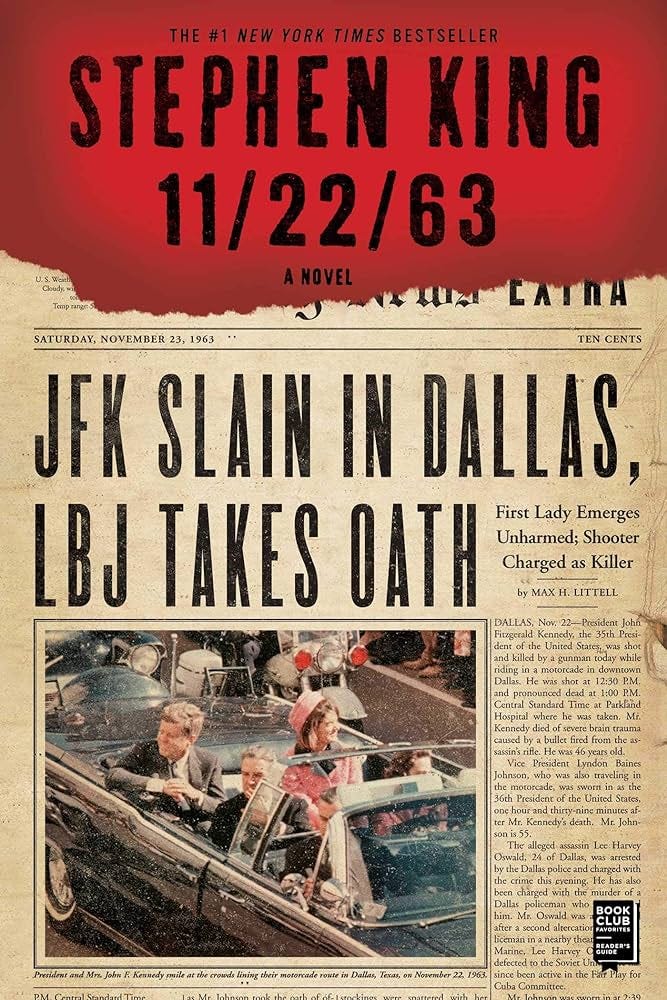
I really struggle with how to write about Stephen King’s novel. I mean, it’s over 800 pages long and I don’t want to spoil any key details for those who might read it! No matter how hard I try, I cannot do the book justice.
Jake Epping is a recently divorced, down-on-his-luck, and depressed High School English teacher. An acquaintance of his shows him a time travel portal and convinces him to go back in time and stop the JFK assassination. The assassination is really in the background of the story until the final third of the novel. The book is about Jake finding himself, falling in love, and realizing the consequences of trying to change the past. If Jake is the protagonist, the past is an obdurate antagonist. It is a wonderful story and well worth the commitment. When I look back at all the books I read towards the end of 2024, I am sure that I will consider 11/22/63 as one of my favorites.
An Interview With My Grandparents
My grandpa called me up about a week ago to ask for a favor and we got to talking about this project that I’ve been working on. He and my grandma were both in high school when the assassination happened so he volunteered to answer any questions that I may have. I had a wonderful 45 minute conversation with both of my grandparents which added a layer to my understanding of this historical event. Here are a few things we discussed:
The significance of President Kennedy being the first Catholic President. My grandparents are both Catholic and Kennedy’s election was very significant to them. There had a been a lot of anti-Catholic prejudice in the 1960s and there was a fear amongst many Catholics that Kennedy had been killed because of his religion. Many Americans of all stripes saw themselves in Kennedy and were inspired by him, but I can see the pain of losing the first Catholic President hitting people of that community the hardest.
Both of my grandparents were in school when it happened. My grandpa had a vivid memory of the news spreading and girls sobbing in the hallway during passing period. My grandma’s principal personally addressed each classroom and arranged for the Rosary to be prayed before dismissal. Her school dismissed early and she and a friend stopped into a convenient store near their bus stop. The owner of the store had the news on a tv. He was in tears as people crowded around to hear the news that the President passed away.
My grandpa pointed out that people’s opinions on Kennedy were divided during his first term. He wasn’t the extremely popular President that we think he was. However, after his assassination, people that disliked him displayed their respect for him. They saw the assassination as an attack on the country. People had the mindset of: “They shot MY President.”
This was the first attack on the country that their generation experienced. Both of my grandparents were too young to have memories of Pearl Harbor. My grandma made the point that people were sad when JFK was shot. People were angry when 9/11 happened. Two different emotions for processing tragedy.
We talked a little bit about the conspiracies and the Warren Report and what might have happened, but in regard to my conversation with them, these are the things that resonated the most with me. They were alive when this historical event happened and the impact it had on them is still there today. It’s a reminder that historical tragedies have human toll to them that we often forget about.
What Lies Ahead
When I set out to publish a Substack about movies, I had no idea that I would diverge into a rabbit hole about the Kennedy assassination. It has been a fascinating month and a half, but I’m ready for it to be done. This is a dark and heavy topic to constantly think about! I’m ready to write about film again. Writing, no matter the subject, is very cathartic and I’m excited to add in more fun to my writing. If things go as planned (they rarely do), here are a few upcoming projects that I’m hoping to write about:
The Martian
The Spider-Verse Movies
Baby Driver or maybe a series on heist movies
Barbie
Moneyball - We’re a few months from baseball season starting, but I spend a lot of time thinking about baseball and it’s cold out and I just want to pretend it’s summer for a couple hours.
Thank you for reading! If you’re new here, I’d love to keep you around as a subscriber! If you already subscribe, thank you! Please tell a friend who can tell a friend and tell them it’s free. I’d love to see this thing grow as I grow as a writer!
Great sub stack to summarize and wrap up all your research on JFK! It is a very heavy topic and there are so many conflicting theories and opinions out there, but you did an excellent job finding and writing about several sources that seem to compliment each other and give some reliable and important information about what may have really happened and why! I am very excited to see what movies you decide to write about next and totally agree about being ready for warmer weather and fun baseball movies!
Wow Josh you connected so many dots with your in-depth look at JFK. We may never know the truth as you point out but the field is narrowed & we know Lee Harvey Oswald was definitely not a lone shooter. What a turbulent, sad time in America. Thanks for bringing together all of these perspectives!